
Sew Much Geometry
Sew Little Time
Introduction
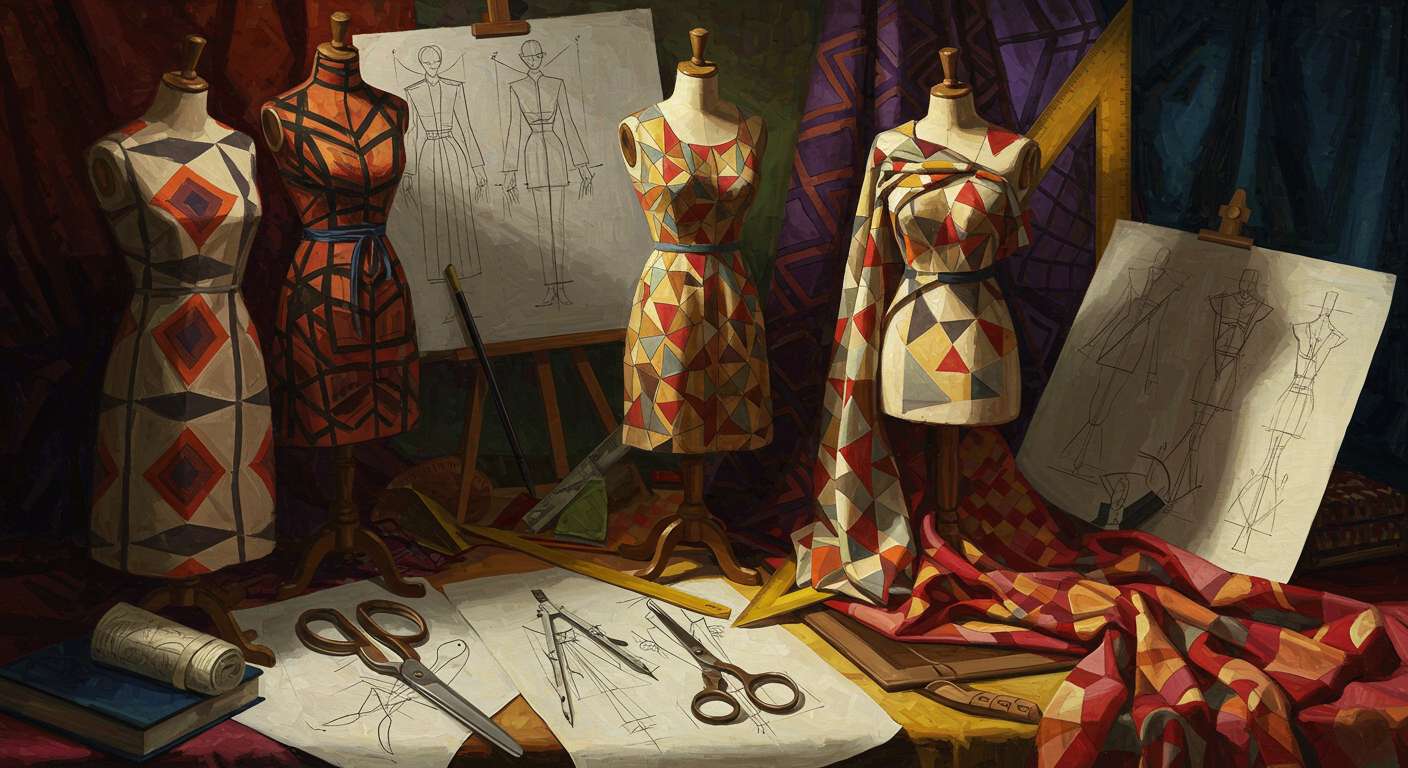
What if the secret to designing the next big trend in fashion was hidden in math? In this project, you’ll discover how iconic fashion designers use geometric shapes, symmetry, and angles to craft bold, eye-catching clothing. Ready to make your own designs? You’ll create fabric patterns, sketch fashion-forward looks, and blend the precision of geometry with the art of style to turn your designs into runway-ready pieces. Get ready to make math your most fashionable accessory!
In this expedition, you'll explore the powerful connection between geometry and fashion design. From symmetrical patterns to angular cuts, fashion designers use geometric principles to create clothing that is both functional and beautiful. Throughout this cycle, you'll get hands-on experience in printmaking to design textile patterns that feature your geometric artwork. You’ll also develop fashion sketches that incorporate your designs and reflect your unique style. By the end of the project, you’ll not only have an amazing collection of designs but also a deeper understanding of how geometry can be used to express creativity in the world of fashion!
Essential Questions
-
What are the basic building blocks of geometry?
-
How are geometric figures and shapes constructed?
-
How do we measure angles and lengths, and how do we determine these values without measuring them directly?
-
What are the unique properties of circles and quadrilaterals, and how can we use them to solve geometric problems?
-
What conclusions can we draw based on the relationship between a circle and the inscribed or circumscribed figures?
Learning Objectives
-
Identify points, lines, rays, and planes within various contexts.
-
Construct and describe angles as acute, obtuse, or right, and use theorems to draw conclusions about line and angle measures.
-
Draw conclusions about geometric figures and length and angle measures, and provide evidence to support their conclusions.
-
Construct geometric figures, including those involving circles and quadrilaterals.
-
Identify transversals and evaluate angle measures related to them.
-
Identify complementary and supplementary angles, and use their properties to calculate missing values.
-
Infer angle measurements for inscribed right triangles and quadrilaterals.
-
Identify and calculate measurements involving arcs, sectors, chords, and secants.
-
Define and identify lines tangent to a circle.
-
Calculate the perimeter of polygons with an inscribed circle, and calculate area and circumference of circles.
-
Identify and apply properties of quadrilaterals, and apply properties of parallel lines and transversals to quadrilaterals.
-
Draw conclusions about geometric figures and length and angle measures, and provide evidence to support their conclusions.
-
Construct geometric figures involving circles and quadrilaterals.