
Design a Green Energy Grid
Become a leader towards positive change in your community.
Introduction
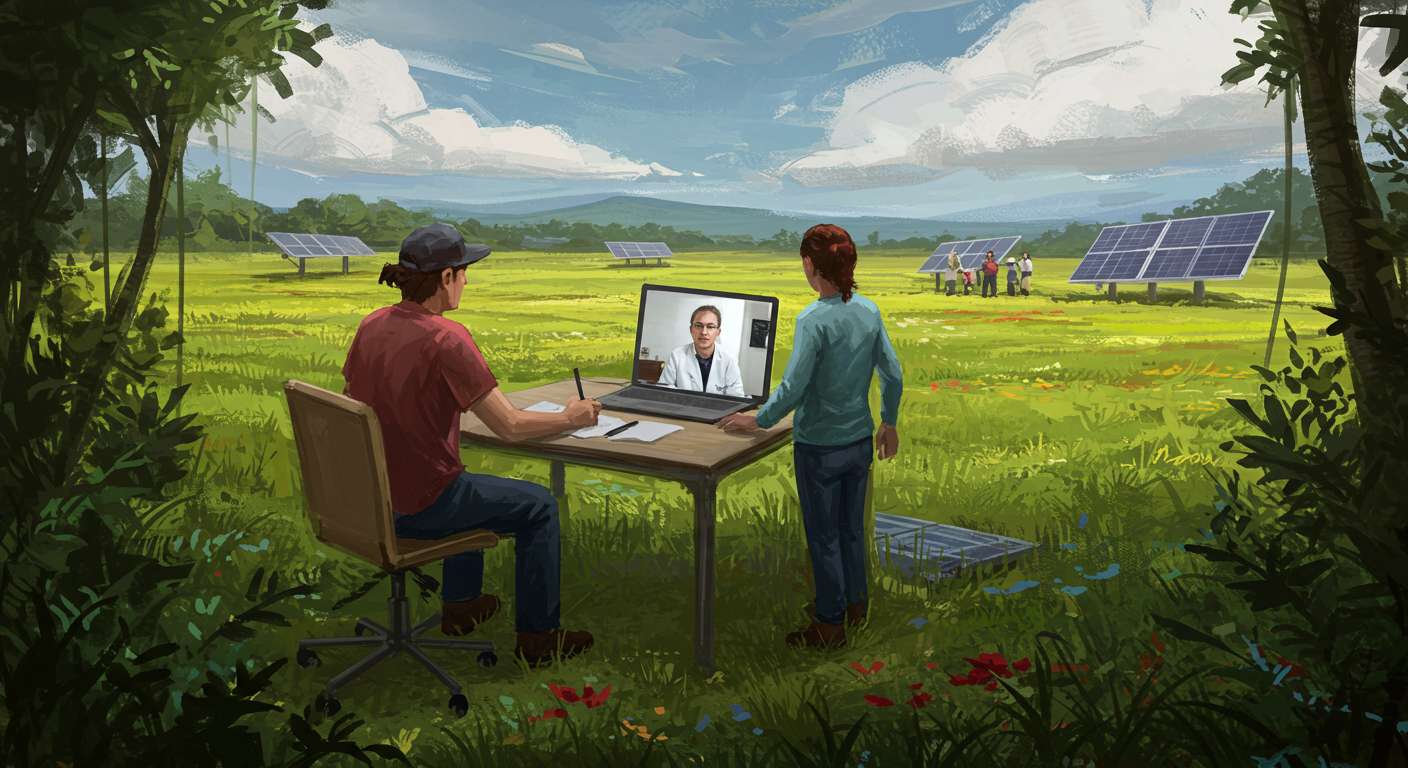
Using the powerful tools of the digital world alongside linear algebra, connect your community to develop a green energy grid (or another important community project) that meets the daily needs of your town. Your challenge? Create a plan that’s both sustainable and cost-effective. Ready to make a real-world impact and power the future with renewable energy? Let’s get started!
In this Algebra 1 expedition, students will build a strong foundation in algebraic concepts, starting with linear equations and their graphical representations. Alongside this, they will explore the basics of digital literacy and the correct use of the most common software programs. Students will explore how to solve and graph equations in various forms, including slope-intercept and standard form. The course will also cover linear inequalities, teaching students to solve, graph, and interpret solutions within real-world contexts. As the course progresses, students will dive into systems of equations and inequalities, applying methods like substitution, elimination, and graphing to solve problems that involve multiple relationships.
Essential Questions
-
What strategies can be used to analyze and solve linear equations and inequalities?
-
What information can we glean from linear equations?
-
How are linear relationships observed in real data?
-
Why are the outcomes of linear relationships important and informative?
-
What information can be gleaned from systems of equations?
-
How are real-world scenarios modeled using systems of equations?
-
What strategies can be used to solve a system of equations?
-
What is a system of equations?
-
Why is it useful to express complex information in a system of equations?
-
What is the Internet, and how does it work to connect people?
-
What are some of the main productivity/office software applications most commonly used?
-
How have the Internet, social media, AI, and other digital technologies impacted society and the interpersonal relationships of the world?
-
What systems can be used to organize files and what are their benefits?
-
How can search engines be used to search for information? How can they be biased?
-
What are some of the basic functionalities of word processors and spreadsheet software?
Learning Objectives
-
Represent relationships with tables and equations.
-
Follow the order of operations to manipulate linear equations.
-
Use appropriate strategies to solve one and two-step linear equations and inequalities, including:
-
Combining like terms
-
Substitution
-
Order of Operations
-
Evaluating graphs
-
Write equations to represent real-world scenarios.
-
Determine the number of solutions to a linear equation.
-
Solve compound inequalities.
-
Use graphs, elimination, or substitution to solve systems of equations.
-
Construct a system of equations to better understand a problem.
-
Graph systems of linear inequalities and interpret solutions.
-
Determine if a system of equations has zero, one, or no solutions.
-
Identify and write equivalent systems of equations.